

Social Security at 62, 67, or 70? A HNW Decision Framework
Balancing lifetime income, portfolio withdrawals, and survivor protection
September 10, 2026
Having enough money to retire does not make the Social Security decision unimportant. It changes the question. A household with substantial investments can often choose whether to spend more from its portfolio now in exchange for a larger monthly benefit later. I would evaluate that exchange alongside health, the surviving spouse's income needs, and the assets available to fund the wait.
There is no single claiming age that is best for every high-net-worth household. The useful objective is a durable retirement plan, including years when one spouse is living alone or neither spouse wants to manage complicated financial decisions.
Start with the benefit you are actually choosing
For people born in 1960 or later, SSA sets full retirement age at 67. Claiming a retirement benefit at 62 reduces it to 70% of the full-retirement-age amount. Waiting from 67 to 70 adds delayed retirement credits equal to 8% of the full benefit for each year of delay, producing 124% at 70. These comparisons assume the same underlying earnings record. Your birth date and actual claiming month matter.1,2
The 8% figure describes an increase in the monthly benefit formula. It is not a return credited to an investment account that you can withdraw or leave to children. Waiting also means giving up payments in the intervening years. Social Security receives cost-of-living adjustments, but the purpose of delaying is to increase the income available if you live long enough to need it.2,6
Put the income difference in dollars
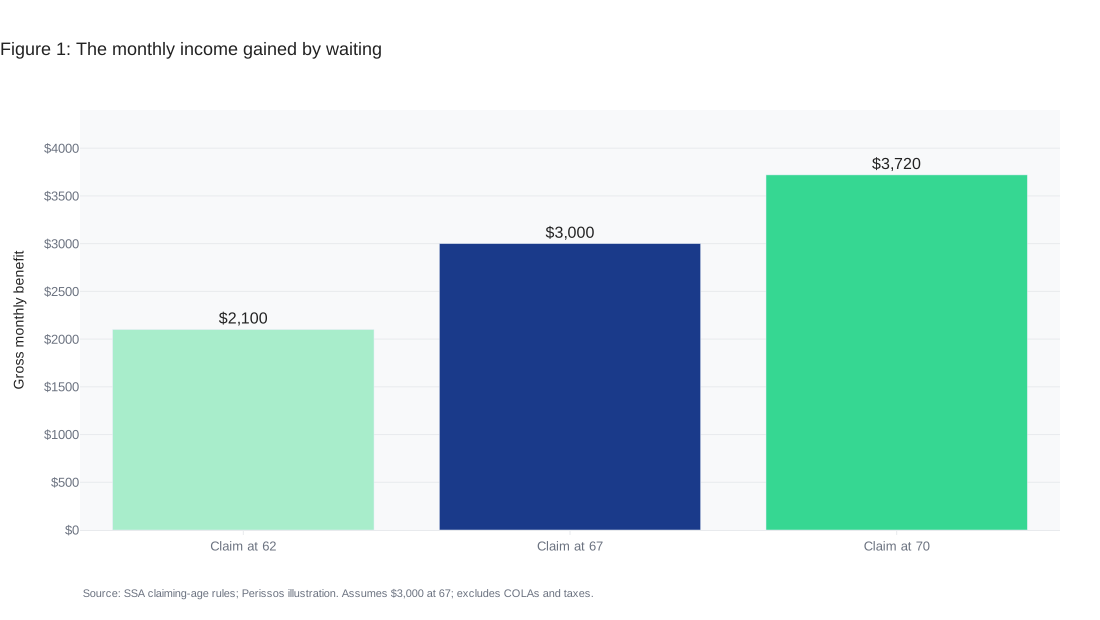
Assume a worker has a $3,000 monthly benefit at full retirement age, is subject to the age-67 schedule, and has no further earnings changes. The comparable gross monthly benefits are $2,100 at 62, $3,000 at 67, and $3,720 at 70. Figure 1 shows that waiting to 70 increases monthly income by $1,620 compared with claiming at 62. These are hypothetical amounts, not a forecast or an estimate from an individual's earnings record.
Waiting from 67 to 70 forgoes $108,000 of gross benefits in this simplified example. The additional $720 per month takes 150 months to recover that amount, putting the undiscounted crossover at approximately age 82½. The calculation deliberately excludes taxes, cost-of-living changes, investment returns, payment-calendar details, and survivor benefits. It is a starting point for discussion, not a recommended claiming age.
That comparison changes when the bridge must be funded from investments. I would identify the accounts that will supply the missing cash, the taxes those withdrawals may create, and what happens if markets fall during the waiting period. A plan that requires selling volatile assets at an inconvenient time deserves a different assessment from one with sufficient cash and short-duration reserves already set aside.
Give the surviving spouse a separate analysis
Delayed retirement credits can increase benefits paid to an eligible surviving spouse. That makes the higher earner's decision especially consequential when the other spouse could live substantially longer. The benefit of waiting may extend beyond the higher earner's lifetime.4
I would compare each spouse's expected income after either death, then compare that income with a realistic survivor spending plan. Household expenses rarely divide neatly in half. Housing, maintenance, and many fixed expenses may remain. A higher dependable income floor can therefore have value even when a household has ample investments.
Know when waiting is a poor fit
Earlier claiming can be reasonable when serious health concerns shorten the expected benefit period, available assets are illiquid, or the household needs the income to avoid financial strain. A strong preference for near-term spending can also be legitimate if the longer-term plan remains sound. The decision should reflect those priorities explicitly.
Continued employment needs a separate check. In 2026, someone below full retirement age all year generally has $1 withheld for each $2 of earnings above $24,480. In the year full retirement age is reached, the rule becomes $1 for each $3 above $65,160, counting earnings before the full-retirement-age month. Beginning that month, earnings no longer reduce benefits. Wages and net self-employment income count; investment income and pensions do not. SSA later adjusts benefits for months affected by earnings-test withholding.3
Taxes are another reason to coordinate the choice with the withdrawal plan: other household income helps determine how much Social Security enters taxable income. Ask the CPA to compare the years before claiming with the years after claiming, rather than evaluating one tax return in isolation.5 Medicare enrollment also needs its own timetable even when Social Security is delayed; waiting on one does not automatically justify waiting on the other.2
Closing
Before submitting an application, obtain benefit estimates that use the same future-earnings assumptions, identify the cash that funds any delay, and review both spouses' income under a long-life scenario. Our team can coordinate that analysis with your CPA and verify the benefit mechanics with SSA.
For a healthy household with adequate liquid reserves, delaying the higher benefit deserves serious consideration. For another household, earlier income may solve a more pressing problem. I want the chosen age to follow from the plan, with the reasoning documented while the tradeoffs are still clear.
All my best,
Brandon VanLandingham, CFA, CMT, CFP
Founder / CIO
Citations
- SSA, Born in 1960 or later. https://www.ssa.gov/benefits/retirement/planner/1960.html (accessed September 10, 2026).
- SSA, Delayed Retirement Credits. https://www.ssa.gov/benefits/retirement/planner/delayret.html (accessed September 10, 2026).
- SSA, Receiving Benefits While Working. https://www.ssa.gov/benefits/retirement/planner/whileworking.html (accessed September 10, 2026).
- SSA, 20 CFR 404.313. https://www.ssa.gov/OP_Home/cfr20/404/404-0313.htm (accessed September 10, 2026).
- IRS, Topic 423. https://www.irs.gov/taxtopics/tc423 (accessed September 10, 2026).
- SSA, Cost-of-Living Adjustment Information. https://www.ssa.gov/cola/ (accessed September 10, 2026).
Important Disclosures
This piece is educational. It is not legal, tax, or accounting advice and is not a recommendation to take or refrain from any specific action. Tax law is fact-specific and changes regularly. Please coordinate any decisions discussed here with your attorney, your CPA, and Perissos before acting.
Perissos Private Wealth Management is a Registered Investment Adviser ("RIA"). Registration as an investment adviser does not imply a certain level of skill or training, and the content of this communication has not been approved or verified by the United States Securities and Exchange Commission or by any state securities authority. Perissos Private Wealth Management renders individualized investment advice to persons in a particular state only after complying with the state's regulatory requirements, or pursuant to an applicable state exemption or exclusion. All investments carry risk, and no investment strategy can guarantee a profit or protect from loss of capital. Past performance is not indicative of future results.
The information contained in this newsletter is intended to provide general information about market themes. It is not intended to offer investment advice. Investment advice will only be given after a client engages our services by executing the appropriate investment services agreement. Information regarding investment products and services is given solely to provide education regarding our investment philosophy and our strategies. You should not rely on any information provided in making investment decisions.
Market data, articles and other content in this material are based on generally available information and are believed to be reliable. Perissos Private Wealth Management does not guarantee the accuracy of the information contained in this material.
Perissos Private Wealth Management will provide all prospective clients with a copy of our current Form ADV, Part 2A (Disclosure Brochure), Part 2B (Supplemental Brochures), and Part 3 (Client Relationship Summary) prior to commencing an advisory relationship. You can also view these documents at any time at adviserinfo.sec.gov or by contacting us requesting a copy.
Explore topics
Share this article
Frequently Asked Questions
- How much is Social Security reduced at age 62 or increased at age 70?
- For people born in 1960 or later, claiming at 62 reduces the retirement benefit to 70% of the full-retirement-age amount at 67. Waiting until 70 raises the benefit to 124% of the full benefit through delayed retirement credits.
- Why might a high-net-worth household delay Social Security?
- A household with ample liquid assets may use portfolio withdrawals to bridge the gap so it can secure a higher guaranteed monthly benefit later. Delaying can also improve income available to an eligible surviving spouse.
- Does delaying Social Security change Medicare enrollment timing?
- No. Medicare has its own enrollment timetable, so delaying Social Security does not automatically mean Medicare should also be delayed.