

The return hurdle, tax tradeoffs, and families most likely to benefit
A charitable lead trust can be a powerful way to combine two goals: support charity for a defined period and transfer whatever remains to family. But the order matters. Charity is paid first. Family receives the remainder later. The trust is irrevocable, and the family does not get a guaranteed result.
That is why I would not begin with the tax deduction. I would begin with a more practical question: Would you still want to make the charitable payments if the wealth-transfer result disappoints? If the answer is no, the structure is probably solving the wrong problem. If the answer is yes, then the math may work—particularly for a family with meaningful transfer-tax exposure, a long time horizon, and assets expected to compound above the IRS valuation rate after taxes, fees, and required distributions.
The structure in plain English
A charitable lead trust, or CLT, is a split-interest trust. It pays a qualified charity for a term of years or, in some designs, for a permitted lifetime. At the end of the charitable period, the remaining assets pass to noncharitable beneficiaries—often children or a trust for their benefit. A charitable lead annuity trust, or CLAT, pays a determinable amount at least annually. A charitable lead unitrust, or CLUT, instead pays a fixed percentage of the trust's value as remeasured each year. All CLTs are irrevocable.1
For a lifetime transfer to family, the taxable gift is generally the value contributed to the trust minus the present value of the charitable payment stream. A CLAT can be designed so that the actuarial value of the charitable annuity is approximately equal to the initial contribution. This is often called a “zeroed-out” CLAT because the actuarial remainder—and therefore the taxable gift—is designed to be near zero. The actual remainder is not guaranteed to be zero. It depends on what the trust earns and what it must pay.1,4
The IRS supplies the valuation hurdle through Internal Revenue Code §7520. For August 2026, that rate is 5.2%. The statute generally uses 120% of the applicable federal mid-term rate, rounded to the nearest two-tenths of one percent. For qualifying charitable transfers, the taxpayer may elect the rate for the transfer month or either of the two preceding months, subject to the consistency rules. The IRS table shows 5.0% for June and 5.2% for July 2026, so an eligible August transfer could use the lower 5.0% June rate. In a level-payment CLAT, that lower input improves the modeled wealth-transfer leverage.2,3
The hurdle is valuation math, not a forecast
The §7520 rate does not predict what the portfolio will earn. It discounts the future charitable payments to determine their present value. In a level-payment, zeroed-out CLAT, the family generally benefits from actual compounding above that hurdle; if net performance merely matches the hurdle, the modeled remainder is approximately zero. Performance below the hurdle can consume the entire remainder and may threaten the trust's ability to complete the scheduled payments.
Figure 1 shows a simplified $5 million, 20-year zeroed-out CLAT using the August 2026 rate of 5.2%. With annual payments at year-end, the modeled charitable annuity is approximately $408,045 per year. That is $8.16 million of scheduled nominal charitable payments over 20 years, even though their actuarial present value is approximately $5 million. If the trust earns a steady 6% net return, about $1.03 million remains for family. At 8%, the remainder is about $4.63 million. At 10%, it is about $10.27 million. At 5.2%, the modeled remainder is approximately zero; at 4%, the trust is depleted before fully satisfying the modeled final payment.
These are deterministic illustrations, not forecasts. “Net return” means after investment fees and any income-tax cost borne by the trust. The model assumes annual compounding, year-end level payments, no additional contributions or distributions, and no state tax, trustee, legal, appraisal, or other administrative cost. Real portfolios experience uneven returns, so an early decline can be more damaging than the same average return earned in a smoother sequence.
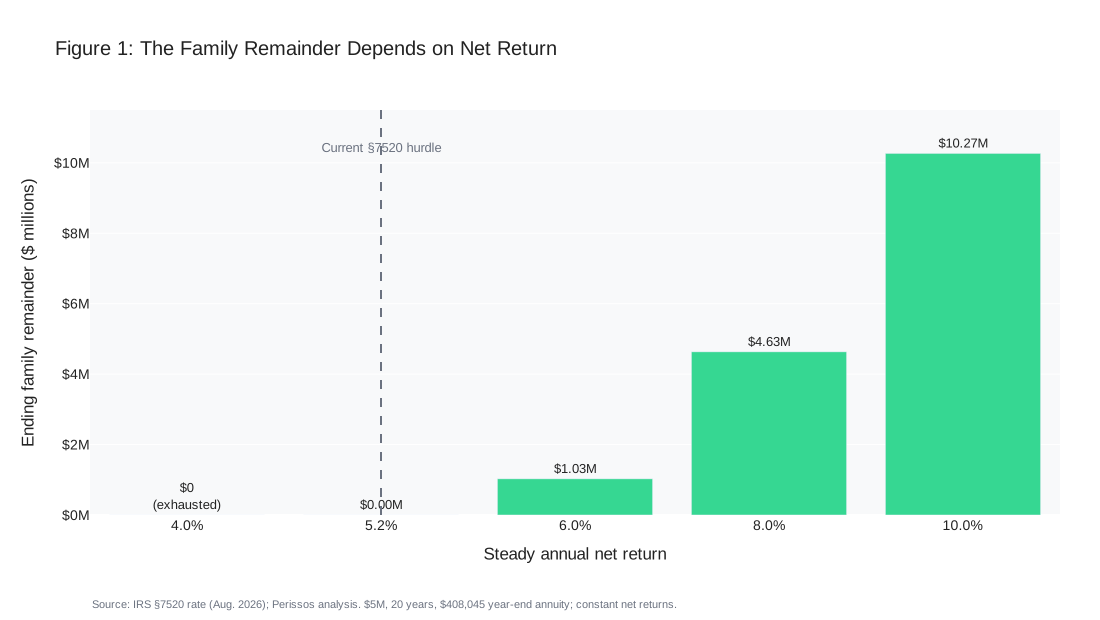
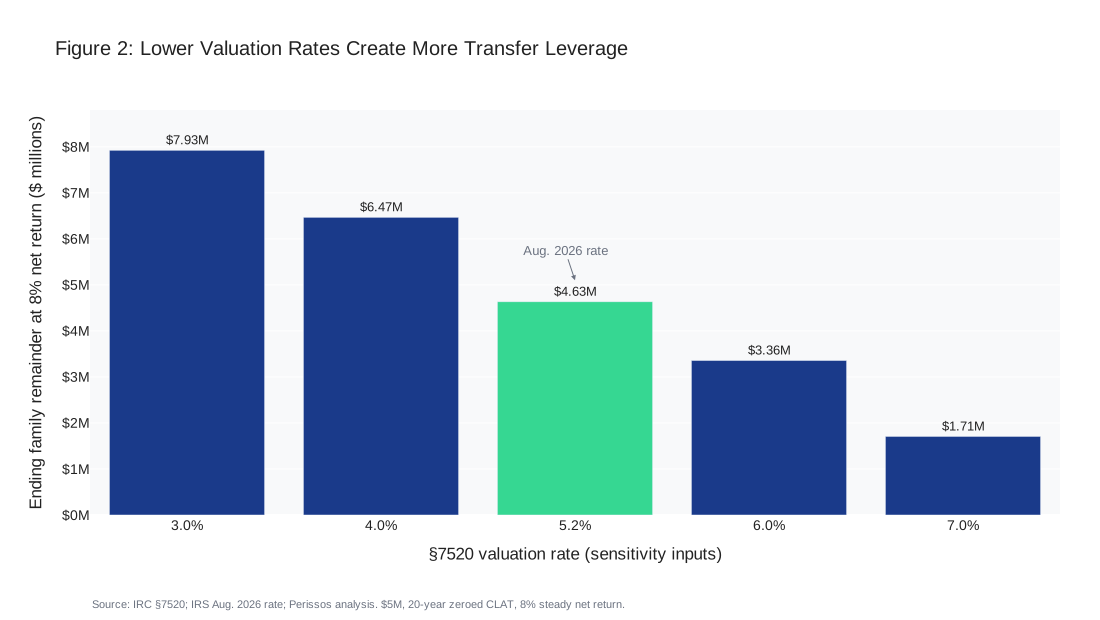
Figure 2 isolates the interest-rate effect. Holding the term at 20 years and the net return at 8%, a lower §7520 rate requires a smaller annual charitable payment to zero the gift and leaves more potential remainder for family. At a 3% valuation rate, the simplified remainder is approximately $7.93 million; at the current 5.2% rate, it is about $4.63 million; at 7%, it falls to about $1.71 million. This is why lower-rate environments are usually more favorable for CLAT wealth-transfer leverage. It is also why the rate should be treated as one input—not the reason to create the trust.
Where the planning advantage actually comes from
Here is the most important point: if an investor holds the same $5 million portfolio outside a trust, earns the same return, and makes the same annual gifts to charity, the pre-transfer-tax ending balance is mathematically similar. The CLAT does not manufacture the $4.63 million remainder in the 8% illustration. Its potential advantage is that future appreciation above the valuation assumption can reach family after the lead term without a second gift-tax valuation at that later, higher amount.
Accordingly, the CLT case is strongest when the family is likely to pay federal or state transfer tax, has already used a meaningful portion of its exclusion, or owns assets whose future appreciation could create exposure. For context, the federal basic exclusion amount is $15 million per individual in 2026, with a separate $15 million generation-skipping transfer exemption; both are scheduled to be indexed after 2026.5 A household well below any realistic transfer-tax threshold may still value a CLT for charitable timing or governance, but the central wealth-transfer arbitrage is weaker.
Term length can increase the potential result because the spread between actual return and the hurdle compounds for longer. It also extends the period of irrevocability, exposes the plan to more tax-law and investment uncertainty, delays family access, and increases the chance that a poor sequence of returns erodes the trust. Longer is not automatically better.
Who is most likely to benefit
The best candidates usually have several characteristics at the same time. They have an authentic, multi-year charitable commitment; assets they can permanently part with; likely estate or gift-tax exposure; and beneficiaries who do not need the assets soon. Their projected net return—not the headline return—is reasonably expected to exceed the selected §7520 rate over the chosen term. The trust also has enough liquidity to make the charitable payment in weak markets without forcing an untimely sale.
CLATs tend to be the more transfer-oriented design because the charity receives a fixed annuity based on initial value and the family receives the remaining upside. A CLUT makes the charity a more direct participant in future growth because its payment resets as a percentage of annual value. The CLUT can be attractive when the donor wants charitable payments to rise and fall with the trust, but it usually provides less concentrated upside leverage to the family.1
The choice between grantor and nongrantor treatment is equally important. With a grantor CLT, the donor may claim an upfront income-tax charitable deduction for the present value of the charitable interest, subject to the applicable deduction limits, while remaining taxable on the trust's income during the lead term. The annual payments do not produce a second charitable deduction. That structure can fit a donor with unusually high current income, enough contribution base to use the deduction, and ample outside cash to absorb future tax bills. If grantor-trust status ends early, recapture rules can apply.4
With a nongrantor CLT, the donor does not receive that upfront income-tax deduction. The trust is a separate taxpayer and may deduct qualifying gross income paid to charity under §642(c). The distinction matters because a required annuity can exceed the trust's current gross income, while retained capital gains or other taxable income may create tax drag. The asset mix, realized-gain policy, and source of each charitable payment therefore deserve year-by-year modeling.1,4
Who is least likely to benefit
A CLT is usually a poor fit when charitable intent is weak, the donor needs access to the assets, or the family cannot tolerate a long delay. It is also less compelling when the estate is unlikely to face transfer tax, when expected net returns are near or below the §7520 rate, or when legal, trustee, tax-return, appraisal, and investment costs are large relative to the amount transferred.
The wrong asset can defeat otherwise attractive math. A high-income, tax-inefficient asset may produce a much lower net return than its headline yield suggests. A concentrated or speculative position may have attractive upside but creates a serious risk that fixed charitable payments force sales after a decline. An illiquid business interest or real-estate holding may not generate enough cash for the annuity. A planned sale of appreciated property also requires careful tax and transaction-timing analysis because a CLT is not generally an income-tax-exempt trust.1
Basis deserves separate attention. Property transferred during life generally carries the donor's basis into the trust, while property acquired from a decedent generally receives a basis tied to date-of-death value, subject to exceptions. Moving a low-basis asset out of the estate can save transfer tax but give up a potential basis adjustment. For a family with little estate-tax exposure and substantial embedded gain, that trade can make a lifetime CLT materially less attractive.6,7
Transfers intended for grandchildren or more remote descendants add another layer. Special generation-skipping transfer rules apply to CLATs, and the ultimate inclusion ratio depends on values at the end of the charitable term. A design that looks efficient for children may be less efficient—or at least less predictable—for skip-person beneficiaries.8
Finally, administration is real. Split-interest trusts have annual information-reporting obligations, and CLTs may also have fiduciary income-tax filing requirements depending on their classification and income. The trustee must value assets, make payments on schedule, track charitable use and deductions, and avoid prohibited transactions.1,9
A practical “does the math work?” test
Before recommending a CLT, our team would model five questions together:
- Charitable commitment: Are the scheduled payments consistent with gifts the family wants to make regardless of the remainder?
- True return spread: After taxes, fees, payment timing, and realistic volatility, is there a reasonable margin above the chosen §7520 rate?
- Transfer-tax value: What federal and state transfer tax is realistically avoided, after accounting for the family's remaining exclusion and the beneficiaries' generation?
- Liquidity and downside: Can the trust fund every charitable payment through a poor market sequence without jeopardizing the broader plan?
- Income-tax and basis cost: Does the upfront deduction, annual trust taxation, and eventual basis result improve the family's total after-tax outcome?
The takeaway is that a CLT works best as a charitable plan with a transfer-tax benefit—not as a tax strategy looking for a charitable purpose. The strongest cases pair durable philanthropic intent with meaningful transfer-tax exposure, patient beneficiaries, sufficient liquidity, and a credible net return spread. The weakest cases rely on optimistic returns, ignore income tax and basis, or assume that “zeroed out” means “risk free.”
Closing
A CLT can turn a long-term charitable budget into a disciplined estate-planning structure. But the decision should be tested against a simpler alternative: retain the assets, make the same gifts directly, and transfer what remains under the existing estate plan. If the CLT does not improve the projected after-tax family result by enough to justify its cost, complexity, and loss of flexibility, the math does not work.
When it does work, implementation should be coordinated across the investment portfolio, estate plan, tax projections, charitable recipients, and trust administration. We would want the estate-planning attorney to draft the instrument, the CPA to test the deduction and annual tax effects, and the investment team to build a liquidity-aware portfolio around the required payments.
All my best,
Brandon VanLandingham, CFA, CMT, CFP
Founder / CIO
Lifetime Gifting Strategies for Families With $10M+
Citations
- Internal Revenue Service, Publication 6109: Technical Guide for Non-Exempt Charitable Trusts and Split-Interest Trusts (May 2025), pp. 27–29. https://www.irs.gov/pub/irs-pdf/p6109.pdf
- Internal Revenue Service, “Section 7520 Interest Rates,” showing a 5.2% rate for August 2026. https://www.irs.gov/businesses/small-businesses-self-employed/section-7520-interest-rates
- 26 U.S.C. §7520, valuation tables and election to use either of the two preceding months for qualifying charitable transfers. https://www.govinfo.gov/link/uscode/26/7520
- Internal Revenue Service, Rev. Proc. 2007-45, 2007-29 I.R.B. 89, sample and annotations for inter vivos grantor and nongrantor CLATs. https://www.irs.gov/irb/2007-29_IRB
- Internal Revenue Service, Rev. Proc. 2025-32, 2025-45 I.R.B., §3.14, 2026 federal basic exclusion and GST exemption amounts. https://www.irs.gov/irb/2025-45_IRB
- 26 U.S.C. §1015, basis of property acquired by gifts and transfers in trust. https://www.govinfo.gov/link/uscode/26/1015
- 26 U.S.C. §1014, basis of property acquired from a decedent. https://www.govinfo.gov/link/uscode/26/1014
- 26 C.F.R. §26.2642-3, special rule for charitable lead annuity trusts. https://www.govinfo.gov/link/cfr/26/26?link-type=pdf§ionnum=2642-3&year=mostrecent
- Internal Revenue Service, Instructions for Form 5227, Split-Interest Trust Information Return (2025). https://www.irs.gov/instructions/i5227
Important Disclosures
This piece is educational. It is not legal, tax, or accounting advice and is not a recommendation to take or refrain from any specific action. Tax law is fact-specific and changes regularly. Please coordinate any decisions discussed here with your attorney, your CPA, and Perissos before acting.
Perissos Private Wealth Management is a Registered Investment Adviser ("RIA"). Registration as an investment adviser does not imply a certain level of skill or training, and the content of this communication has not been approved or verified by the United States Securities and Exchange Commission or by any state securities authority. Perissos Private Wealth Management renders individualized investment advice to persons in a particular state only after complying with the state's regulatory requirements, or pursuant to an applicable state exemption or exclusion. All investments carry risk, and no investment strategy can guarantee a profit or protect from loss of capital. Past performance is not indicative of future results.
The information contained in this newsletter is intended to provide general information about market themes. It is not intended to offer investment advice. Investment advice will only be given after a client engages our services by executing the appropriate investment services agreement. Information regarding investment products and services is given solely to provide education regarding our investment philosophy and our strategies. You should not rely on any information provided in making investment decisions.
Market data, articles and other content in this material are based on generally available information and are believed to be reliable. Perissos Private Wealth Management does not guarantee the accuracy of the information contained in this material.
Perissos Private Wealth Management will provide all prospective clients with a copy of our current Form ADV, Part 2A (Disclosure Brochure), Part 2B (Supplemental Brochures), and Part 3 (Client Relationship Summary) prior to commencing an advisory relationship. You can also view these documents at any time at adviserinfo.sec.gov or by contacting us requesting a copy.
Sources
Explore topics
Share this article
Last reviewed: August 14, 2026
Frequently Asked Questions
- What is a zeroed-out CLAT?
- A zeroed-out Charitable Lead Annuity Trust is designed so the actuarial present value of the charitable payments equals the initial contribution, resulting in a taxable gift value of approximately zero.
- How does the Section 7520 rate affect a CLT?
- The §7520 rate acts as a valuation hurdle; if the trust's net investment performance exceeds this rate, the excess growth can typically pass to heirs without additional gift tax.
- What happens if a CLT underperforms the hurdle rate?
- If the trust earns less than the §7520 rate, the remainder for heirs may be depleted or reduced to zero, and the trust may struggle to fulfill its charitable payment obligations.