

Written and reviewed by Brandon VanLandingham, CFA, CMT, CFP® · Last updated August 27, 2026
Two ways to turn a retirement portfolio into a paycheck
August 22, 2026
One of the harder transitions in retirement is moving from accumulation to distribution. During the working years, the question is usually, "How much should I save, and how should it be invested?" In retirement, the question becomes more practical: "Where does my next paycheck come from, and what do we do when markets are down?"
Two common answers are the bucket strategy and the total return approach. They are often presented as opposing philosophies. I think that is too rigid. In real planning work, both are ways to solve the same problem: how to fund spending while keeping enough long-term growth in the portfolio to support a retirement that may last several decades.
The better question is not which label sounds more comfortable. The better question is which operating system gives a particular household the clearest discipline for taxes, cash flow, risk, and behavior.
The Shared Starting Point
Both approaches start with asset allocation. The SEC describes asset allocation as dividing investments among asset classes such as stocks, bonds, and cash, with the right mix depending on time horizon and risk tolerance.1 That matters because a retirement income plan is not only a withdrawal plan. It is an asset allocation plan with a spending rule attached.
Both approaches also rely on diversification and rebalancing. Diversification can reduce risk by spreading money across investments, while rebalancing brings the portfolio back toward its target allocation after market movements push it out of alignment.1 A bucket strategy may describe those jobs in plain cash-flow language. A total return approach may describe them in portfolio-management language. Underneath, the same questions still need to be answered:
How much should be held in cash or short-term reserves? How much volatility can the plan tolerate? Which account should fund spending this year? When should we refill cash? When should we let the portfolio heal? How do required distributions, taxes, charitable giving, and estate goals change the answer?
How A Bucket Strategy Works
A bucket strategy divides the portfolio by time horizon. The first bucket usually holds near-term spending in cash or very conservative instruments. A second bucket often holds intermediate-term assets such as high-quality bonds or other lower-volatility investments. A third bucket holds long-term growth assets.
The appeal is obvious. If the stock market falls, the retiree can see that the next year or two of planned withdrawals is not dependent on selling stocks at depressed prices. That visibility can make it easier to stay invested. For some households, the psychological value is not a minor feature. It is the feature that helps them avoid a bad decision at the wrong time.
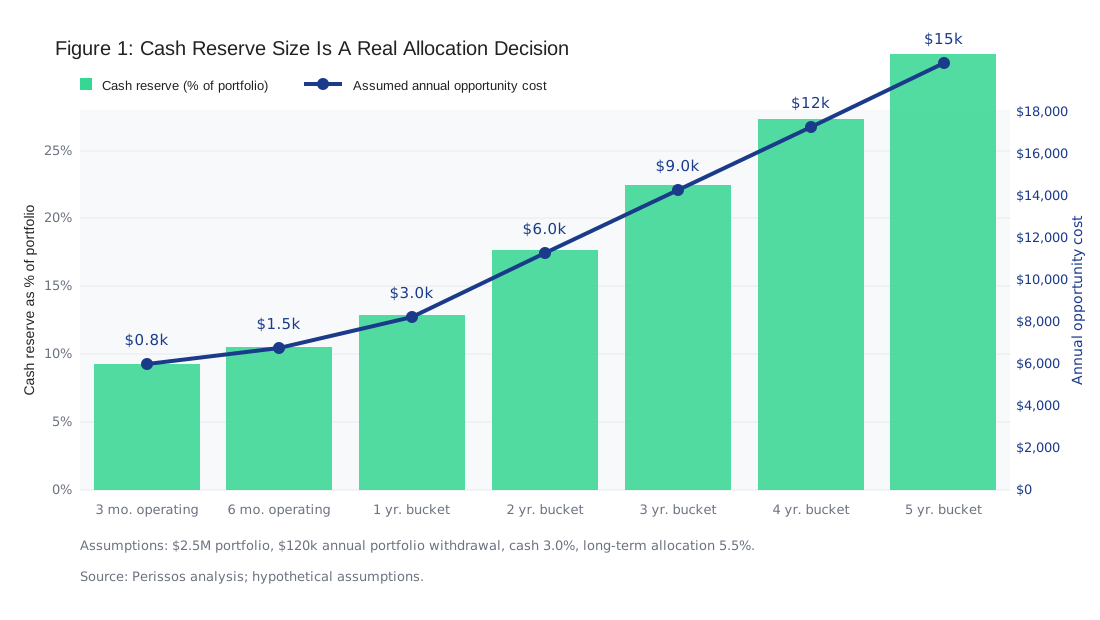
The tradeoff is that a large cash bucket is still an investment decision. Cash can be useful, but it normally carries reinvestment risk and may lag a long-term diversified allocation over time. Figure 1 shows the practical issue. Using a hypothetical $2.5 million portfolio and a $120,000 annual portfolio-funded spending need, each additional year of cash reserve raises the cash allocation and the assumed one-year opportunity cost. The chart uses a 3.0% cash return and a 5.5% long-term blended portfolio return as assumptions, not forecasts.
A bucket strategy works best when the buckets are governed by rules. Without rules, the first bucket can become a permanent pile of idle cash, or the growth bucket can become something the retiree is afraid to touch. The right question is not, "Do we have buckets?" It is, "When do we spend from each bucket, and what evidence tells us to refill it?"
How A Total Return Approach Works
A total return approach usually starts with one diversified portfolio and one target allocation. Spending is funded from the portfolio's total return: interest, dividends, realized gains, scheduled withdrawals, and periodic rebalancing. Instead of assigning each dollar to a time bucket, the plan asks the whole portfolio to support the withdrawal policy.
The strength of this approach is efficiency. The portfolio can be managed around the household's risk capacity, time horizon, tax situation, and estate goals without forcing assets into visible compartments. Cash is still used, but typically as an operating reserve rather than a multi-year wall between the retiree and the market.
Total return also pairs naturally with tax-aware withdrawal planning. A given year's spending may come from taxable accounts, traditional retirement accounts, Roth accounts, cash, or a combination. The IRS says required minimum distributions generally apply to traditional IRAs, SEP IRAs, SIMPLE IRAs, 401(k), 403(b), 457(b), profit-sharing, and other defined contribution plans, and that RMD withdrawals are generally included in taxable income except for basis or tax-free qualified distributions.2 SECURE 2.0 increased the applicable RMD age to 73 for certain cohorts and to 75 for later cohorts.3 Those rules do not decide the investment strategy, but they often affect which assets should be sold, which account should distribute, and when tax planning should happen.
The weakness of total return is that it can feel abstract. In a difficult market, "we are rebalancing the portfolio" may be technically correct but emotionally thin. If the retiree cannot connect that process to next month's spending, the approach may be harder to stick with.
What Figure 1 Is Really Showing
The decision is not whether cash is good or bad. The decision is how much cash is enough for the plan's purpose.
A total return framework might keep three to six months of planned withdrawals in operating cash, with additional liquidity available through bonds, dividends, interest, or scheduled rebalancing. A bucket framework might intentionally hold one, two, or three years of planned withdrawals in the first bucket. Both can be reasonable. But a five-year cash bucket in the example would represent 24.0% of the entire portfolio. That may be appropriate for a very risk-sensitive household, but it should be chosen deliberately because it changes the return burden on the rest of the portfolio.
Figure 1 shows why this is a planning decision, not a branding decision.
When The Bucket Strategy May Fit Better
The bucket strategy may be a better fit when the retiree needs a very visible spending reserve to stay disciplined. It can also help couples who think about risk differently. One spouse may care most about near-term paycheck stability; the other may care most about long-term growth. Buckets can make that conversation concrete.
It can also work well when spending is naturally segmented. For example, a retiree might have a near-term travel budget, a known home project, or a bridge period before Social Security, pension income, or other cash flow begins. In those cases, labeling certain dollars for specific time windows may improve decision-making.
The caution is that bucket strategies can create false precision. A "three-year bucket" does not eliminate market risk, inflation risk, tax risk, or longevity risk. It simply changes how those risks are organized. If the bucket rules are vague, the retiree can still end up selling the wrong assets at the wrong time, just with different labels on the accounts.
When Total Return May Fit Better
The total return approach may be a better fit when the household is comfortable managing the portfolio as one coordinated system. It is often cleaner for retirees with multiple account types, meaningful taxable assets, charitable intent, Roth conversion opportunities, concentrated positions, or estate-planning goals.
It can also reduce the tendency to overfund cash. A household that already has stable pension income, Social Security, or other reliable cash flow may not need several years of portfolio withdrawals sitting in cash. For that household, the more important risk may be failing to maintain enough long-term growth.
The caution is behavioral. A total return plan needs a clear withdrawal policy, a rebalancing discipline, and a communication process. If the plan only says, "Sell what we need when we need it," it is not a strategy. It is an administrative habit.
The Perissos View
I do not view bucket strategy and total return as enemies. I view them as different ways to organize the same retirement income engine.
In practice, I usually want three things documented. First, what is the household's real spending need from the portfolio after accounting for Social Security, pensions, earned income, rental income, or other reliable sources? Second, what liquidity reserve is required so the client can live with the plan during bad markets? Third, what target allocation and tax-aware withdrawal order give the plan a reasonable chance to support the full retirement horizon?
That may produce a pure bucket strategy. It may produce a total return strategy with a named cash reserve. Often, it produces a hybrid: enough cash to make the paycheck visible, enough bonds or lower-volatility assets to manage sequence risk, and enough growth exposure to preserve purchasing power over time.
The implementation should also be coordinated with the client's CPA and attorney where tax, estate, charitable, or account-titling decisions are involved. Retirement income is not just an investment question. It is a multi-year planning question, and the account we spend from this year can affect taxes, future RMDs, Medicare premiums, charitable planning, and the assets eventually left to heirs.
Closing
The takeaway is simple: bucket strategy is usually better at communication; total return is usually better at integration. The right plan may borrow from both.
A well-designed retirement income process should tell you where this year's paycheck comes from, what happens after a market decline, how cash gets replenished, and how tax-aware account selection fits into the plan. If those rules are clear, the label matters less. If those rules are missing, neither label will protect the retiree from poor decisions.
All my best,
Brandon VanLandingham, CFA, CMT, CFP
Founder / CIO
Citations
- SEC Investor.gov, "Asset Allocation and Diversification," retrieved August 22, 2026, https://www.investor.gov/introduction-investing/getting-started/asset-allocation.
- Internal Revenue Service, "Retirement topics - Required minimum distributions (RMDs)," retrieved August 22, 2026, https://www.irs.gov/retirement-plans/plan-participant-employee/retirement-topics-required-minimum-distributions-rmds.
- Internal Revenue Service, Internal Revenue Bulletin 2026-06, retrieved August 22, 2026, https://www.irs.gov/irb/2026-06_IRB.
Important Disclosures
This piece is educational. It is not legal, tax, or accounting advice and is not a recommendation to take or refrain from any specific action. Tax law is fact-specific and changes regularly. Please coordinate any decisions discussed here with your attorney, your CPA, and Perissos before acting.
Perissos Private Wealth Management is a Registered Investment Adviser ("RIA"). Registration as an investment adviser does not imply a certain level of skill or training, and the content of this communication has not been approved or verified by the United States Securities and Exchange Commission or by any state securities authority. Perissos Private Wealth Management renders individualized investment advice to persons in a particular state only after complying with the state's regulatory requirements, or pursuant to an applicable state exemption or exclusion. All investments carry risk, and no investment strategy can guarantee a profit or protect from loss of capital. Past performance is not indicative of future results.
The information contained in this newsletter is intended to provide general information about market themes. It is not intended to offer investment advice. Investment advice will only be given after a client engages our services by executing the appropriate investment services agreement. Information regarding investment products and services is given solely to provide education regarding our investment philosophy and our strategies. You should not rely on any information provided in making investment decisions.
Market data, articles and other content in this material are based on generally available information and are believed to be reliable. Perissos Private Wealth Management does not guarantee the accuracy of the information contained in this material.
Perissos Private Wealth Management will provide all prospective clients with a copy of our current Form ADV, Part 2A (Disclosure Brochure), Part 2B (Supplemental Brochures), and Part 3 (Client Relationship Summary) prior to commencing an advisory relationship. You can also view these documents at any time at adviserinfo.sec.gov or by contacting us requesting a copy.
Sources
Explore topics
Share this article
Last reviewed: August 22, 2026
Frequently Asked Questions
- What is the primary difference between a bucket strategy and a total return approach?
- A bucket strategy segments a portfolio by time horizon for psychological visibility, whereas a total return approach manages a single diversified portfolio for maximum efficiency.
- How does a bucket strategy impact long-term portfolio returns?
- Holding large amounts of cash in an immediate-term bucket can create an opportunity cost if those funds underperform a diversified long-term allocation over time.
- Which approach is better for tax-aware withdrawal planning?
- The total return approach often pairs naturally with tax planning by allowing retirees to draw from taxable, tax-deferred, or Roth accounts based on current IRS rules and RMD requirements.