

The Augusta Rule is easy to explain and just as easy to oversell. A homeowner may exclude the rent received from a dwelling used as a residence when the home is rented for fewer than 15 days during the year. Pair that exclusion with a legitimate business that needs meeting space, and the business may also have a rent deduction. That sounds like one rule creating two tax benefits. It is not.
The homeowner's exclusion and the business's deduction are separate questions. Section 280A(g) governs the homeowner. The business still has to prove that the rent was an ordinary and necessary business expense, that the home was actually used for business, and that the amount was reasonable. I view the strategy as useful for the right owner and the right meeting—not as an annual ritual that should be forced into every closely held company.
The takeaway: the tax result follows the business facts. A lease and a check cannot manufacture those facts after year-end.
Where the Rule Came From
Congress added Section 280A in the Tax Reform Act of 1976 as part of a broader set of limits on deductions connected with homes and vacation properties. The original explanation said that when a dwelling used as a residence was rented for fewer than 15 days, neither operating gain nor operating loss would be recognized for federal income-tax purposes.^1^ That is the historical core of what planning professionals now call the Augusta Rule.
The statute was not written specifically for business owners renting a dining room to their own corporation. It is a short-duration home-rental rule. The owner-business technique combines that rule with the ordinary rules for deducting business rent. Keeping those two pieces separate is the best way to understand both the opportunity and the risk.
Two Separate Tax Questions
On the homeowner's side, current Section 280A(g) applies when a dwelling unit is used as a residence and is actually rented for fewer than 15 days during the tax year. The rent is excluded from the homeowner's gross income, but the homeowner cannot deduct expenses attributable to those rental days.^2,3^ The rule can apply to a main home or another qualifying dwelling; IRS guidance includes houses, apartments, condominiums, mobile homes, boats, vacation homes, and similar properties with basic living accommodations.^3^
"Fewer than 15" means no more than 14 rental days. It also means total rental days for the dwelling, not 14 days for the business plus another allowance for a vacation renter. If the home is rented for 15 days or more and is used as a home, the IRS says all rental income must be included, with expenses divided between rental and personal use under the vacation-home rules.^3^ The property must also qualify as a home: personal use must exceed the greater of 14 days or 10% of the days rented at a fair rental price.^3^
On the business side, a rent payment is deductible only when the property is used in the business. The IRS also states that unreasonable rent is not deductible and that related-party rent is reasonable when it is the same amount the business would pay a stranger for the same property.^4^ That is the harder test in most owner-business arrangements. Section 280A(g) may exclude valid rent from the homeowner's income, but it does not bless an inflated payment, a personal gathering labeled as a meeting, or a meeting the business did not need.
How It Is Typically Used
The most common version involves a closely held corporation renting an owner's residence for a limited number of substantive meetings. Quarterly planning sessions, an annual leadership retreat, a board meeting, or a day devoted to budgeting and succession planning can fit when the home is a sensible venue and the company would otherwise need comparable space. The rental should cover the space and time the business actually needs. An eight-hour meeting in a dining room and living area is not automatically worth the overnight rate for an entire luxury home.
Let's look at a simple illustration. Assume comparable local meeting space supports rent of $1,250 per day. Four quarterly meetings would produce $5,000 of rent. If the owner uses the property as a residence, the dwelling has no other rental days, and every meeting and payment is legitimate, the $5,000 falls below the 15-day threshold on the homeowner's side. The business would separately test its $5,000 deduction under the ordinary, necessary, and reasonable standards.^2,3,4^
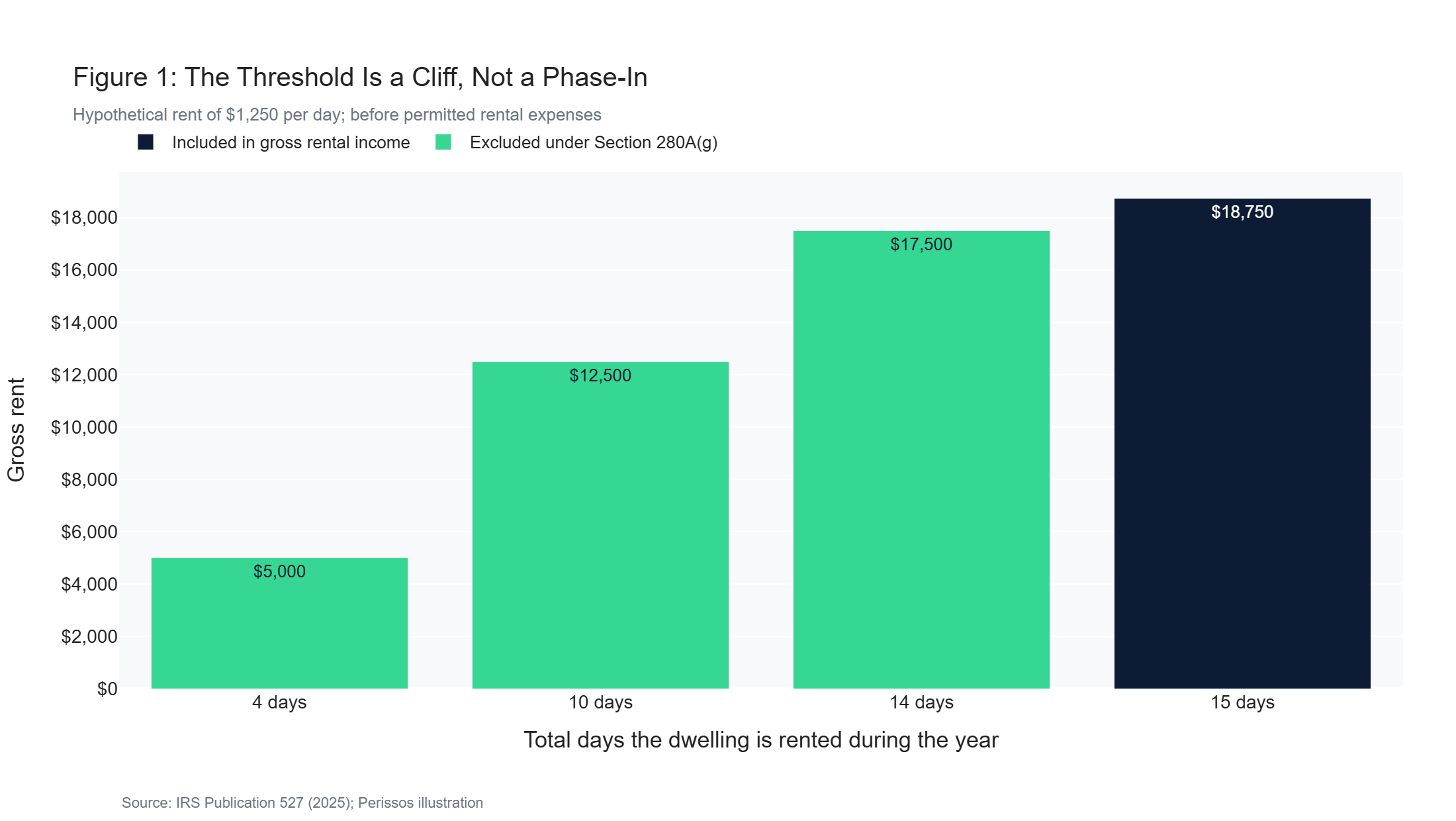
Figure 1 shows why I call the threshold a cliff rather than a phase-in. At the same hypothetical daily rate, rent from four, 10, or 14 days is within the exclusion. At 15 days, the full $18,750 becomes reportable rental income before considering any permitted rental expenses; only the final day's rent does not become taxable.^3^ The 14-day ceiling is therefore a guardrail, not a target. A company should schedule only the meetings it genuinely needs.
What Good Implementation Looks Like
Good implementation begins before the meeting. The company should identify the business purpose, the people who need to attend, why the home is an appropriate venue, and the portion of the property and hours being rented. The governing body should approve the arrangement under the entity's normal procedures, and a short written rental agreement should describe the date, space, duration, purpose, and rate. For a corporation, contemporaneous minutes matter; the IRS specifically tells corporations to keep board minutes.^5^
The rate memo deserves the same care as the meeting agenda. I would want several contemporaneous local comparables for meeting or event space, adjusted for square footage actually used, duration, furnishings, privacy, technology, food preparation, parking, and location. IRS guidance defines fair rental price by what an unrelated person would pay and points to purpose, size, condition, furnishings, and location when comparing properties.^3^ A whole-home event listing may be a poor comparable for a six-person planning meeting. The evidence should support the rate, not merely surround a rate chosen in advance.
After the meeting, keep the agenda, attendee list, minutes or work product, invoice, proof of payment, and the fair-rent analysis together. The payment should move from the business account to the homeowner and appear correctly in the company's books. IRS recordkeeping guidance says the records must support reported deductions, and supporting documents include invoices, receipts, account statements, and canceled checks; proof of payment alone does not establish the deduction.^5^ The homeowner should also maintain a year-to-date count of every day the dwelling was rented to anyone.
Information reporting, state and local tax, short-term rental rules, insurance, mortgage terms, and homeowners-association restrictions can add another layer. This is the framework; the specifics are a conversation with us, your CPA, and your attorney before the first rental date.
Who Benefits Most
The strongest candidate is an owner of a profitable, separately recognized business entity that has a real, occasional need for private meeting space. A corporation with multiple decision-makers, scheduled governance meetings, and no convenient conference room presents cleaner facts than an owner working alone at the kitchen table. The home should be genuinely suitable, the local market should provide credible comparables, and the owner should use it as a residence while keeping total rental days comfortably below 15.
The benefit is usually more compelling when the business deduction has current value, the company would otherwise incur a venue cost, and the administrative work is modest relative to the rent. It can also work well when privacy or uninterrupted time has a business purpose—for example, a strategic planning session involving sensitive financial, personnel, or succession matters. Those facts should be recorded honestly. "Privacy" should not become a generic explanation pasted onto every agenda.
I also prefer the strategy when the owner already maintains disciplined books and governance records. The incremental work is then small: approve the rental, support the price, hold the meeting, preserve the record, and make the payment. Like a bridge, the structure is only useful if both sides reach solid ground. Here, one side is Section 280A(g), and the other is the business deduction.
Who Benefits Least
The weakest fit is a sole proprietor or an individual-owned single-member LLC that has not elected corporate tax treatment. The IRS treats that LLC as disregarded for federal income-tax purposes and reports its activities on the owner's return, much like a sole proprietorship.^6^ A taxpayer generally cannot create a meaningful federal income-tax rent deduction by paying himself through an entity that is not separate from him for that purpose.
The strategy is also a poor fit for a business with little or no current taxable income, an owner who already rents the property for other uses near or above the 15-day threshold, or a property that does not qualify as a residence. It is especially weak when the "meeting" is primarily personal, the owner would never pay an unrelated venue the proposed amount, or the company already has suitable space and cannot explain why another venue was helpful and appropriate.
Multi-owner businesses require care as well. A payment to one owner's household may change the economics among owners even when the tax rules can be satisfied. The operating agreement, corporate approval process, related-party policies, and allocation of the benefit all matter. If the expected tax savings are small, legal, accounting, valuation, and recordkeeping costs can consume the advantage.
The Mistakes That Usually Matter
The first mistake is treating 14 days as an automatic annual entitlement. It is merely the outer boundary of one income exclusion. The second is pricing the home by aspiration rather than evidence. A rate based on the home's value, the owner's desired deduction, or an unrelated overnight event is not the same as the market price for the space and hours the business actually used.
The third mistake is documenting form but not substance. A rental agreement proves that someone drafted a rental agreement. It does not prove that the meeting occurred, that the attendees worked on the business, or that the rate was reasonable. Agendas, calendars, minutes, work product, comparables, invoices, and bank records should tell one consistent story.^5^
The final mistake is reviewing the threshold one rental at a time. The owner must count the dwelling's total rental days for the entire year. A few personal short-term rentals after the business meetings can push the property to 15 days and change the homeowner's reporting result for all the rent.^2,3^
All my best,
Brandon VanLandingham, CFA, CMT, CFP
Founder/CIO
Section 1202 (QSBS): The HNW Founder's Best Tax Break
How to Use a Defined Benefit Plan as a Late-Career Tax Shield
Net Investment Income Tax (NIIT): What Triggers It and How to Plan
Citations
- Joint Committee on Taxation, General Explanation of the Tax Reform Act of 1976, discussion of Section 280A
- Joint Committee on Taxation, Present Law and Background Relating to Residential Real Estate (JCX-4-23), March 3, 2023
- IRS Publication 527, Residential Rental Property (Including Rental of Vacation Homes), 2025
- IRS Publication 334, Tax Guide for Small Business, 2025
- IRS Publication 583, Starting a Business and Keeping Records
- IRS, Single Member Limited Liability Companies
Important Disclosures
This piece is educational. It is not legal, tax, or accounting advice and is not a recommendation to take or refrain from any specific action. Tax law is fact-specific and changes regularly. Please coordinate any decisions discussed here with your attorney, your CPA, and Perissos before acting.
Perissos Private Wealth Management is a Registered Investment Adviser ("RIA"). Registration as an investment adviser does not imply a certain level of skill or training, and the content of this communication has not been approved or verified by the United States Securities and Exchange Commission or by any state securities authority. Perissos Private Wealth Management renders individualized investment advice to persons in a particular state only after complying with the state's regulatory requirements, or pursuant to an applicable state exemption or exclusion. All investments carry risk, and no investment strategy can guarantee a profit or protect from loss of capital. Past performance is not indicative of future results.
The information contained in this newsletter is intended to provide general information about market themes. It is not intended to offer investment advice. Investment advice will only be given after a client engages our services by executing the appropriate investment services agreement. Information regarding investment products and services is given solely to provide education regarding our investment philosophy and our strategies. You should not rely on any information provided in making investment decisions.
Market data, articles and other content in this material are based on generally available information and are believed to be reliable. Perissos Private Wealth Management does not guarantee the accuracy of the information contained in this material.
Perissos Private Wealth Management will provide all prospective clients with a copy of our current Form ADV, Part 2A (Disclosure Brochure), Part 2B (Supplemental Brochures), and Part 3 (Client Relationship Summary) prior to commencing an advisory relationship. You can also view these documents at any time at adviserinfo.sec.gov or by contacting us requesting a copy.
Sources
Explore topics
Share this article
Last reviewed: August 5, 2026
Frequently Asked Questions
- What is Augusta Rule: Renting Your Home to Your Business?
- Augusta Rule: Renting Your Home to Your Business is covered in detail in this article from Perissos Private Wealth, which explains the key concepts and how they apply to your financial plan.
- Why does Augusta Rule: Renting Your Home to Your Business matter for retirement planning?
- Understanding Augusta Rule: Renting Your Home to Your Business helps you make more informed decisions about income, taxes, and risk as you approach and enter retirement.
- How can I learn more about Augusta Rule: Renting Your Home to Your Business?
- Read the full article above, or schedule a no-obligation conversation with a Perissos Private Wealth advisor to discuss how Augusta Rule: Renting Your Home to Your Business fits your situation.