

A Solo 401(k) and a SEP IRA can reach the same headline contribution ceiling, but they do not take the same road to get there. The Solo 401(k) lets an owner contribute in two capacities—first as an employee and then as the employer. A SEP is funded by the employer alone. That difference matters most when business income is healthy but not yet high enough for a 20% or 25% employer contribution to reach the annual limit.
I view the choice as a business-design decision before I view it as an investment-account decision. The owner's compensation, age, other workplace plans, expected hiring, tax-return timing, and appetite for paperwork can all change the answer. For an Oklahoma owner, the state tax and creditor-protection rules add useful context, but the federal plan rules still drive the comparison.
The Same Ceiling, but a Different Path
For 2026, the basic 401(k) elective-deferral limit is $24,500. A participant age 50 or older may contribute an additional $8,000 if the plan permits catch-up contributions, while someone who turns age 60, 61, 62, or 63 during 2026 may use the higher $11,250 catch-up limit. The combined defined-contribution limit, excluding catch-up contributions, is $72,000, and compensation taken into account for plan purposes is generally capped at $360,000.1
A SEP IRA has the same $72,000 overall ceiling, but it does not permit elective salary deferrals or SEP catch-up contributions. For an employee, including an owner-employee of a corporation, the employer contribution is generally limited to the lesser of 25% of compensation or $72,000. A Solo 401(k) can combine the $24,500 employee deferral with an employer contribution, subject to the same $72,000 combined ceiling before catch-ups.2,3
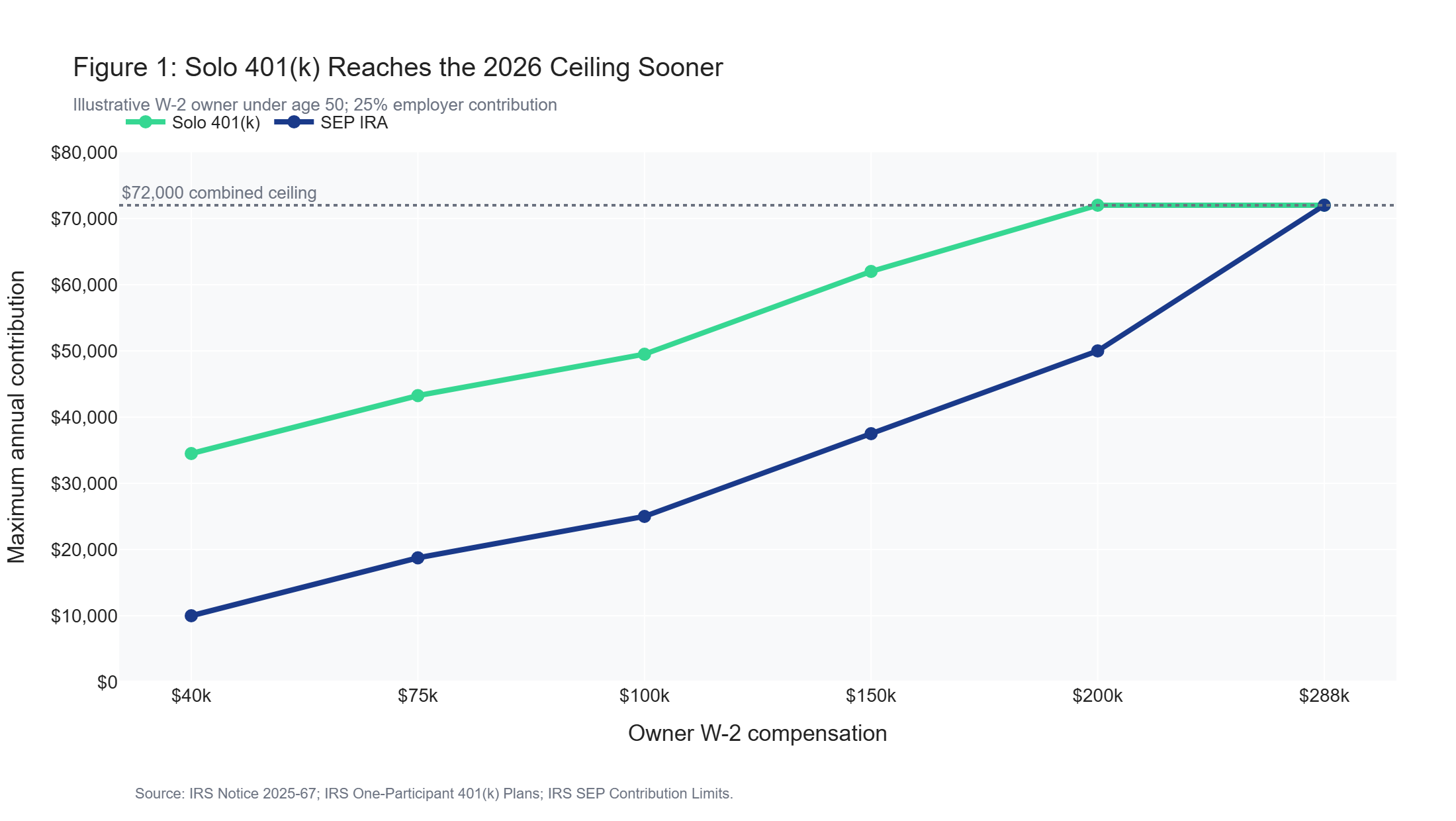
Figure 1 shows why the Solo 401(k) often wins at moderate compensation. The illustration assumes an owner under age 50 receiving W-2 compensation, no contribution to another employer plan, a 25% employer contribution, and enough cash flow to fund the maximum. At $100,000 of W-2 compensation, the SEP contribution is $25,000, while the Solo 401(k) can reach $49,500 by adding the $24,500 employee deferral. At $288,000, both plans can reach $72,000. The Solo advantage is therefore not a higher base ceiling; it is the ability to reach that ceiling sooner.1,2,3
Compensation Is the Real Starting Point
The clean 25% calculation applies to W-2 compensation. An unincorporated owner uses a different formula. For a sole proprietor or partner, plan compensation is based on net earnings from self-employment after deducting one-half of self-employment tax and the contribution for the owner. The practical result is that a stated 25% employer rate generally becomes a 20% maximum rate when applied to adjusted net earnings before the owner's plan contribution. IRS Publication 560 provides the worksheet because the contribution itself affects the compensation base.2,4
That distinction is easy to miss. If an unincorporated owner has $100,000 of adjusted net earnings before the plan contribution, the employer component is generally $20,000, not $25,000. A SEP would stop there. A Solo 401(k) for an owner under age 50 could add a $24,500 employee deferral and reach $44,500, assuming no other limit intervenes.2,4
S corporation owners face a different trap: shareholder distributions do not count as retirement-plan compensation. Both employee deferrals and employer contributions must be based on W-2 wages. Paying a $60,000 salary and taking the rest as distributions does not create a $200,000 retirement-plan contribution base.6 The retirement-plan design and the reasonable-compensation analysis therefore need to be modeled together with the CPA.
An owner with a day job must also coordinate limits. The $24,500 elective-deferral limit is a per-person limit across 401(k) plans, not a fresh limit for each plan. If the owner already defers $18,000 into an employer's 401(k), only $6,500 of regular elective-deferral room remains for the Solo 401(k). The owner's separate business may still make an employer contribution, subject to the applicable compensation, deduction, related-employer, and annual-addition rules.2
Employees Can Change the Answer
A Solo 401(k) is designed for a business owner with no common-law employees, or for the owner and the owner's spouse. Partnerships can also maintain a one-participant plan for partners and their spouses when there are no common-law employee participants. Once an employee satisfies the plan's eligibility rules, the plan is no longer simply "solo"; the employee generally must be included, and testing or a qualifying safe-harbor design may be required.2 Employee eligibility can arise sooner than many owners expect because a 401(k) generally cannot require more than one year of service or, for elective-deferral access, two consecutive 12-month periods with at least 500 hours of service.4
A SEP can cover employees, but simplicity does not mean cost-free. Under the IRS model SEP and most standard SEP arrangements, eligible employees receive the same contribution percentage as the owner. The plan may generally require an employee to be at least age 21, to have worked for the employer in at least three of the preceding five years, and to receive at least $800 of compensation in 2026. When the owner contributes, eligible employees who performed services during the year generally must receive their allocation even if they left before the contribution was made.1,3
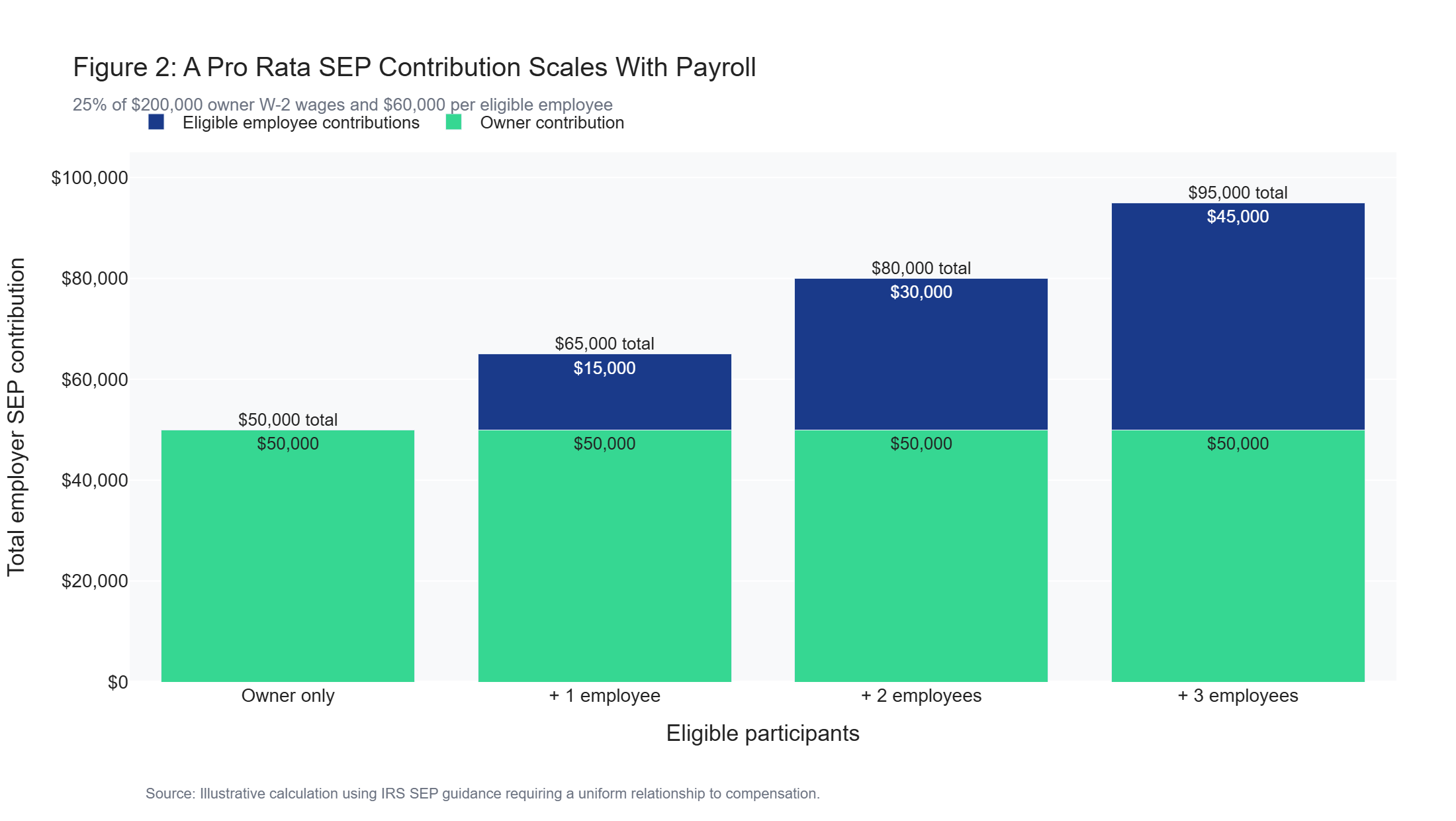
Figure 2 illustrates the cost of a 25% pro rata SEP contribution for an owner with $200,000 of W-2 compensation and eligible employees earning $60,000 each. The owner receives $50,000, but each eligible employee adds a $15,000 employer contribution. With three such employees, the business funds $95,000 in total SEP contributions to deliver $50,000 to the owner. The point is not that employee contributions are undesirable; it is that the owner should price the full promise before adopting the plan.3
Related businesses deserve the same review. Controlled-group and affiliated-service-group rules can require employees of commonly owned or service-related businesses to be considered together for retirement-plan purposes. An owner cannot assume that placing payroll in one entity and the retirement plan in another makes the employees disappear.10
Administration, Deadlines, and Access
The SEP is the simpler instrument. It can generally be established and funded by the due date of the employer's federal income-tax return, including extensions. The employer may choose a contribution from zero up to the plan's limit each year, and the employer generally does not file Form 5500 for the SEP. Each participant owns an IRA, is immediately vested, and controls the investments inside that account.3,4
The Solo 401(k) requires a written qualified-plan document, contribution elections, recordkeeping, and more attention to deadlines. Employer profit-sharing contributions can generally be funded by the employer's return due date, including extensions. Owner-employee deferrals generally must be elected by year-end. A narrow first-year exception allows an individual who wholly owns an unincorporated business and is its only employee to adopt a new 401(k) after year-end and make the first-year deferral by the individual's unextended return due date. I would still treat year-end establishment and a written deferral election as the cleaner operating discipline rather than relying on a retroactive exception.4
Once total assets across the owner's one-participant plans reach $250,000 at year-end, Form 5500-EZ or an eligible Form 5500-SF is generally required for each plan. A final return is required when the plan terminates even if assets are below $250,000. This is not difficult work, but missed filings can create penalties, which is why the plan should have an annual compliance calendar.5
Access and tax character also differ. A Solo 401(k) may allow participant loans if the document permits them, generally capped at the lesser of $50,000 or 50% of the vested account balance, subject to the plan-loan rules. A SEP IRA cannot offer loans.5 A Solo 401(k) can offer pre-tax and designated Roth employee deferrals, and current law also permits certain vested employer contributions to be designated Roth when the plan allows it. SECURE 2.0 likewise permits Roth SEP contributions, but the employer and IRA provider must support the feature, and the Roth employer contribution creates current taxable income.9
There is one more planning detail I would not overlook. A traditional SEP IRA is part of the taxpayer's aggregate traditional IRA balance for Form 8606. That balance can make a backdoor Roth conversion partly taxable under the pro-rata rule. A Solo 401(k) balance is not entered as a traditional IRA balance on Form 8606. For a high-income owner who uses annual backdoor Roth contributions, keeping pre-tax dollars inside a qualified plan can be a meaningful structural advantage.7
The Oklahoma Layer
Oklahoma's individual return starts with federal adjusted gross income. A deductible retirement-plan contribution that reduces federal income therefore generally reduces the Oklahoma starting point as well, subject to the taxpayer's entity structure and any Oklahoma-specific adjustments. For 2026, Oklahoma's top individual income-tax rate is 4.5%.8 The state deduction is not a separate SEP or Solo 401(k) incentive; it is generally the state consequence of the federal deduction.
Oklahoma law also broadly exempts interests in federally tax-qualified or tax-deferred retirement arrangements from attachment, execution, or forced sale, subject to the state's fraudulent-transfer rules. The statute expressly includes defined-contribution plans, individual retirement accounts, and simplified employee pension plans.11 That gives both structures meaningful Oklahoma protection, although bankruptcy, domestic-relations orders, federal tax claims, prohibited transactions, and transfers made to hinder creditors require separate legal analysis.
At the distribution stage, current Oklahoma Tax Commission guidance permits each individual to exclude up to $10,000 of qualifying retirement benefits included in federal adjusted gross income. The listed sources include Section 401 plans and Section 408 IRAs and SEPs. The exclusion is useful, but it should not drive today's plan selection because future law, residency, Roth treatment, and the household's distribution pattern may all be different by retirement.11
Who Is Likely to Benefit?
The strongest Solo 401(k) candidate is an owner-only business, or an owner-and-spouse business, that wants to save aggressively before compensation is high enough for an employer-only contribution to reach the limit. The case becomes stronger when the owner is age 50 or older, values Roth deferrals or a possible plan-loan feature, wants to keep pre-tax assets outside the Form 8606 IRA aggregation rule, and is comfortable maintaining a compliance calendar.
The SEP is often the cleaner fit for an owner who values late establishment, minimal administration, and flexible employer-only contributions. It can be especially reasonable when compensation is already high enough to reach the desired contribution through the employer formula, no catch-up contribution is needed, no plan loan is desired, and the SEP balance will not interfere with a backdoor Roth strategy. A SEP can also work with employees when the owner intentionally wants a uniform employer contribution and has modeled the cost.
Neither plan should be chosen in isolation when hiring is likely. A growing business may be better served by a regular safe-harbor 401(k), a SIMPLE IRA, or a broader qualified-plan design rather than repeatedly repairing an owner-only arrangement. Likewise, a consistently profitable owner seeking contributions beyond the defined-contribution ceiling may need to evaluate a cash-balance or other defined-benefit plan. Those are separate designs with different cost and funding commitments, but they belong in the conversation before the owner assumes the choice is limited to two acronyms.
What does this mean for your plan? Start with a current-year compensation projection by entity, list every worker and related business, inventory all other retirement accounts, and decide how much the business actually wants to fund for the owner and employees. Then compare contribution capacity, taxes, administration, and future flexibility on the same page. This is the framework; the specifics are a conversation with your CPA, business attorney, plan administrator, and Perissos before documents are signed or money moves.
Closing
The Solo 401(k) is usually the more powerful savings tool for an owner-only business because the employee deferral fills the account faster. The SEP is usually the easier tool because it strips away most of the qualified-plan administration. Power and simplicity are both valuable. The right priority depends on the business.
The takeaway is to choose the plan you can operate correctly for several years, not the one with the best headline this December. Our team will continue coordinating retirement contributions with the owner's tax projection, entity compensation, hiring plan, and broader investment strategy so the account supports the business rather than surprising it.
All my best,
Brandon VanLandingham, CFA, CMT, CFP
Lifetime Gifting Strategies for Families With $10M+
Reducing Capital Gains on a Highly Appreciated Portfolio
The Hidden Costs of "Buy and Hold" for Retirees Drawing Income
Citations
[1] Internal Revenue Service, Notice 2025-67, 2026 Amounts Relating to Retirement Plans and IRAs, Internal Revenue Bulletin 2025-49, https://www.irs.gov/irb/2025-49_IRB. The notice lists the 2026 $24,500 elective-deferral limit, $72,000 defined-contribution limit, $8,000 general catch-up, $11,250 catch-up for ages 60 through 63, $360,000 compensation limit, and $800 SEP eligibility threshold.
[2] Internal Revenue Service, One-Participant 401(k) Plans (updated April 9, 2026), https://www.irs.gov/retirement-plans/one-participant-401k-plans. The IRS explains owner employee-and-employer contributions, the shared elective-deferral limit across plans, self-employed compensation calculations, employee coverage, and the $250,000 filing threshold.
[3] Internal Revenue Service, Simplified Employee Pension Plan (SEP), https://www.irs.gov/retirement-plans/plan-sponsor/simplified-employee-pension-plan-sep; Retirement Plans: FAQs Regarding SEPs, https://www.irs.gov/retirement-plans/retirement-plans-faqs-regarding-seps; and SEP Contribution Limits, https://www.irs.gov/retirement-plans/plan-participant-employee/sep-contribution-limits-including-grandfathered-sarseps. These pages address SEP funding, eligibility, uniform contributions, deadlines, filing requirements, vesting, loans, and the 2026 limit.
[4] Internal Revenue Service, Publication 560 (2025), Retirement Plans for Small Business, https://www.irs.gov/publications/p560; and Deductibility of Employer Contributions to a 401(k) Plan Made After the End of the Tax Year (June 2026), https://www.irs.gov/retirement-plans/issue-snapshot-deductibility-of-employer-contributions-to-a-401k-plan-made-after-the-end-of-the-tax-year. Publication 560 is the latest edition available as of July 30, 2026 and includes 2026 indexed amounts. These sources explain self-employed contribution calculations, employee eligibility, contribution timing, and the limited first-year retroactive deferral rule for a sole proprietor.
[5] Internal Revenue Service, Financial Advisors: Are Assets in Your Clients' One-Participant Plans More Than $250,000?, https://www.irs.gov/retirement-plans/financial-advisors-are-assets-in-your-clients-one-participant-plans-more-than-250000; Operating a 401(k) Plan, https://www.irs.gov/retirement-plans/operating-a-401k-plan; and Retirement Topics—Loans, https://www.irs.gov/retirement-plans/plan-participant-employee/retirement-topics-loans. These sources cover Form 5500-EZ filing and final-return rules and the loan distinction between qualified plans and IRA-based plans.
[6] Internal Revenue Service, Retirement Plan FAQs Regarding Contributions—S Corporation (updated April 8, 2026), https://www.irs.gov/retirement-plans/retirement-plan-faqs-regarding-contributions-s-corporation. The IRS states that S corporation shareholder distributions are not earned income for retirement-plan purposes and that contributions are based on W-2 compensation.
[7] Internal Revenue Service, Instructions for Form 8606 (2025), https://www.irs.gov/instructions/i8606. These are the latest Form 8606 instructions available as of July 30, 2026. They define traditional IRAs to include traditional SEP and SIMPLE IRAs and require the year-end value of all traditional IRAs in the pro-rata calculation.
[8] Oklahoma Tax Commission, 2025 Tax Legislation Summary, https://oklahoma.gov/content/dam/ok/en/tax/documents/resources/publications/legislation/2025LegislativeUpdate.pdf; 2026 Packet OW-2 Oklahoma Income Tax Withholding Tables, https://www.oklahoma.gov/content/dam/ok/en/tax/documents/resources/publications/businesses/withholding-tables/WHTables-2026.pdf; and 2025 Form 511 Resident Packet and Instructions, https://oklahoma.gov/content/dam/ok/en/tax/documents/forms/individuals/current/511-Pkt.pdf. These sources show the 2026 4.5% top individual rate and that the Oklahoma resident return begins with federal adjusted gross income.
[9] Internal Revenue Service, SECURE 2.0 Act Impacts How Businesses Complete Forms W-2, https://www.irs.gov/newsroom/secure-2-point-0-act-impacts-how-businesses-complete-forms-w-2; and Simplified Employee Pension Plan (SEP), https://www.irs.gov/retirement-plans/plan-sponsor/simplified-employee-pension-plan-sep. The IRS explains Roth SEP elections and optional Roth treatment for certain vested employer contributions.
[10] Internal Revenue Service, Chapter 7—Controlled and Affiliated Service Groups, https://www.irs.gov/pub/irs-tege/epchd704.pdf. The IRS explains that employees across a controlled group must be considered as employees of one employer for qualified-plan purposes.
[11] Oklahoma Legislature, Oklahoma Statutes, Title 31, Section 1(A)(20), https://www.oklegislature.gov/OK_Statutes/CompleteTitles/os31.pdf; and Oklahoma Tax Commission, Income Tax Help Center—Retirement Income, https://oklahoma.gov/tax/helpcenter/income-tax.html. The statute describes Oklahoma's retirement-plan exemption, and the Tax Commission describes the current retirement-income exclusion for qualifying Section 401 and Section 408 distributions.
Important Disclosures
This piece is educational. It is not legal, tax, or accounting advice and is not a recommendation to take or refrain from any specific action. Tax law is fact-specific and changes regularly. Please coordinate any decisions discussed here with your attorney, your CPA, and Perissos before acting.
Perissos Private Wealth Management is a Registered Investment Adviser ("RIA"). Registration as an investment adviser does not imply a certain level of skill or training, and the content of this communication has not been approved or verified by the United States Securities and Exchange Commission or by any state securities authority. Perissos Private Wealth Management renders individualized investment advice to persons in a particular state only after complying with the state's regulatory requirements, or pursuant to an applicable state exemption or exclusion. All investments carry risk, and no investment strategy can guarantee a profit or protect from loss of capital. Past performance is not indicative of future results.
The information contained in this newsletter is intended to provide general information about market themes. It is not intended to offer investment advice. Investment advice will only be given after a client engages our services by executing the appropriate investment services agreement. Information regarding investment products and services is given solely to provide education regarding our investment philosophy and our strategies. You should not rely on any information provided in making investment decisions.
Market data, articles and other content in this material are based on generally available information and are believed to be reliable. Perissos Private Wealth Management does not guarantee the accuracy of the information contained in this material.
Perissos Private Wealth Management will provide all prospective clients with a copy of our current Form ADV, Part 2A (Disclosure Brochure), Part 2B (Supplemental Brochures), and Part 3 (Client Relationship Summary) prior to commencing an advisory relationship. You can also view these documents at any time at adviserinfo.sec.gov or by contacting us requesting a copy.
Sources
Explore topics
Share this article
Last reviewed: July 31, 2026
Frequently Asked Questions
- What is the primary contribution difference between a Solo 401(k) and a SEP IRA?
- A Solo 401(k) allows for both employee elective deferrals and employer contributions, whereas a SEP IRA is funded solely by employer contributions. This allows Solo 401(k) participants to reach the maximum $72,000 ceiling at lower compensation levels than S...
- How do 2026 catch-up contributions work for business owners over age 50?
- Solo 401(k) plans permit an $8,000 catch-up for those 50+, while those aged 60-63 in 2026 may contribute a higher $11,250 catch-up. Conversely, SEP IRAs generally do not permit elective salary deferrals or standard catch-up contributions.
- How does hiring employees affect a Solo 401(k)?
- A Solo 401(k) is designed for owners and their spouses with no common-law employees. Once an employee meets eligibility rules—typically one year of service or 500 hours over two years—they must generally be included, which may require complex testing and sa...